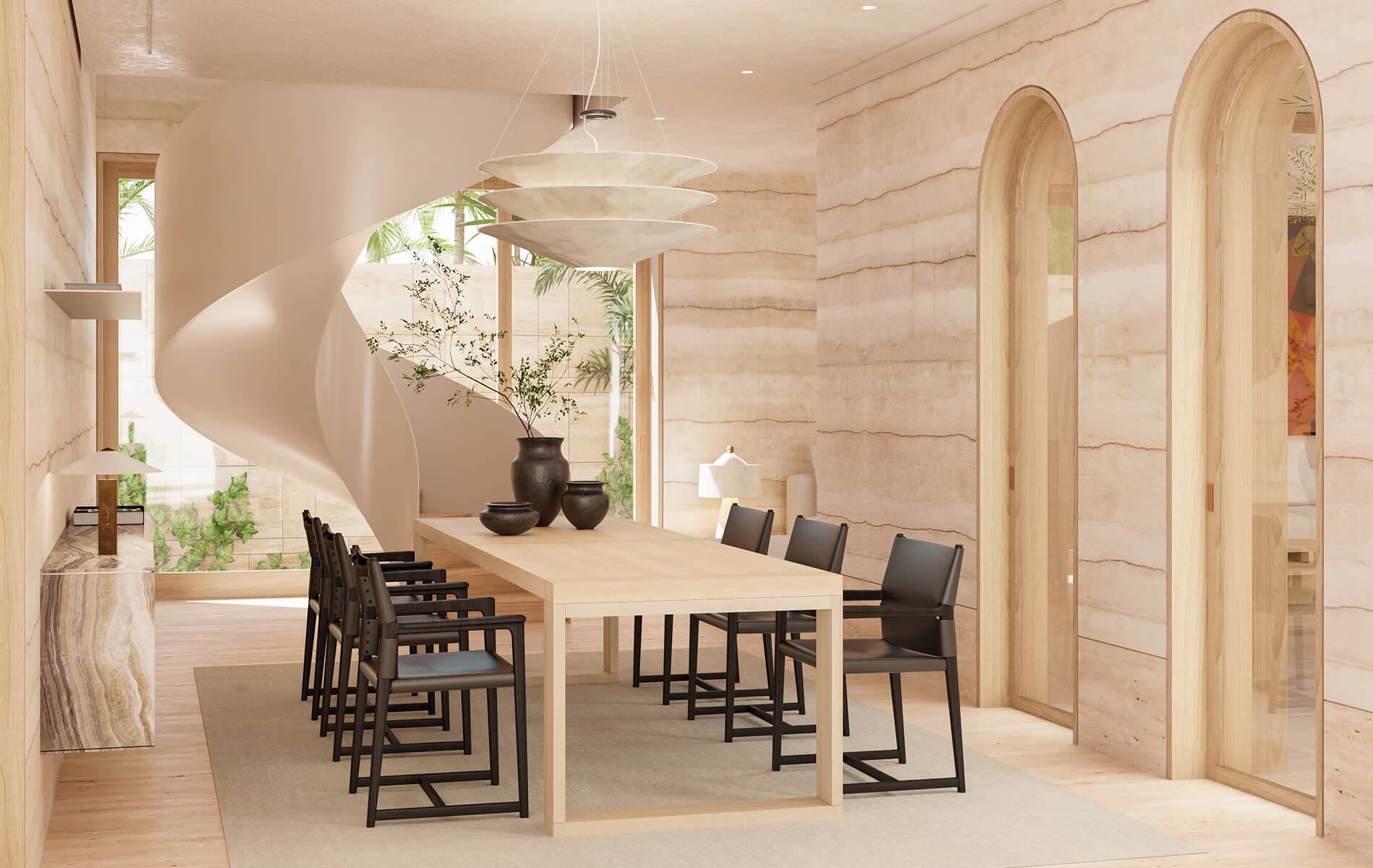
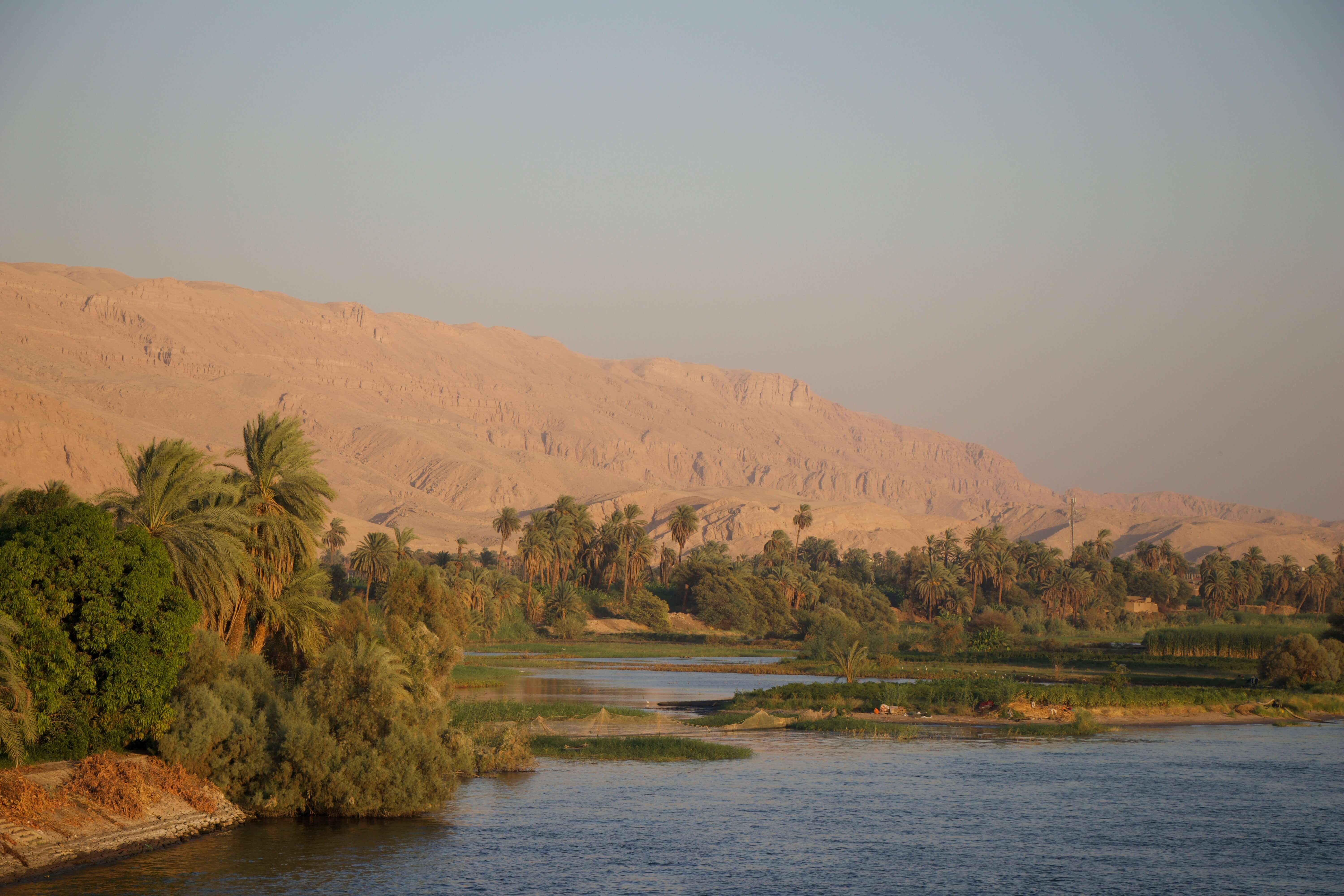
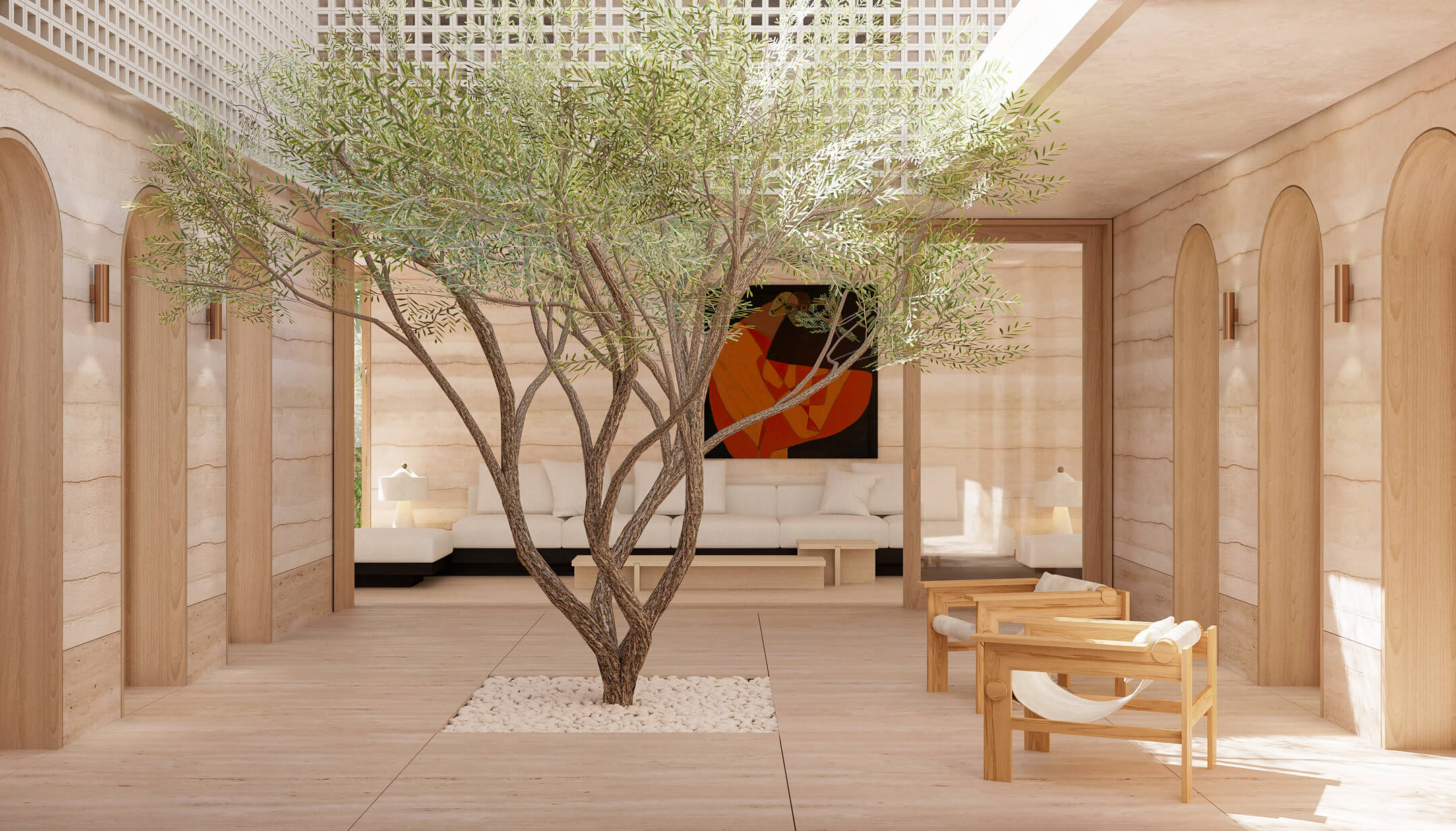
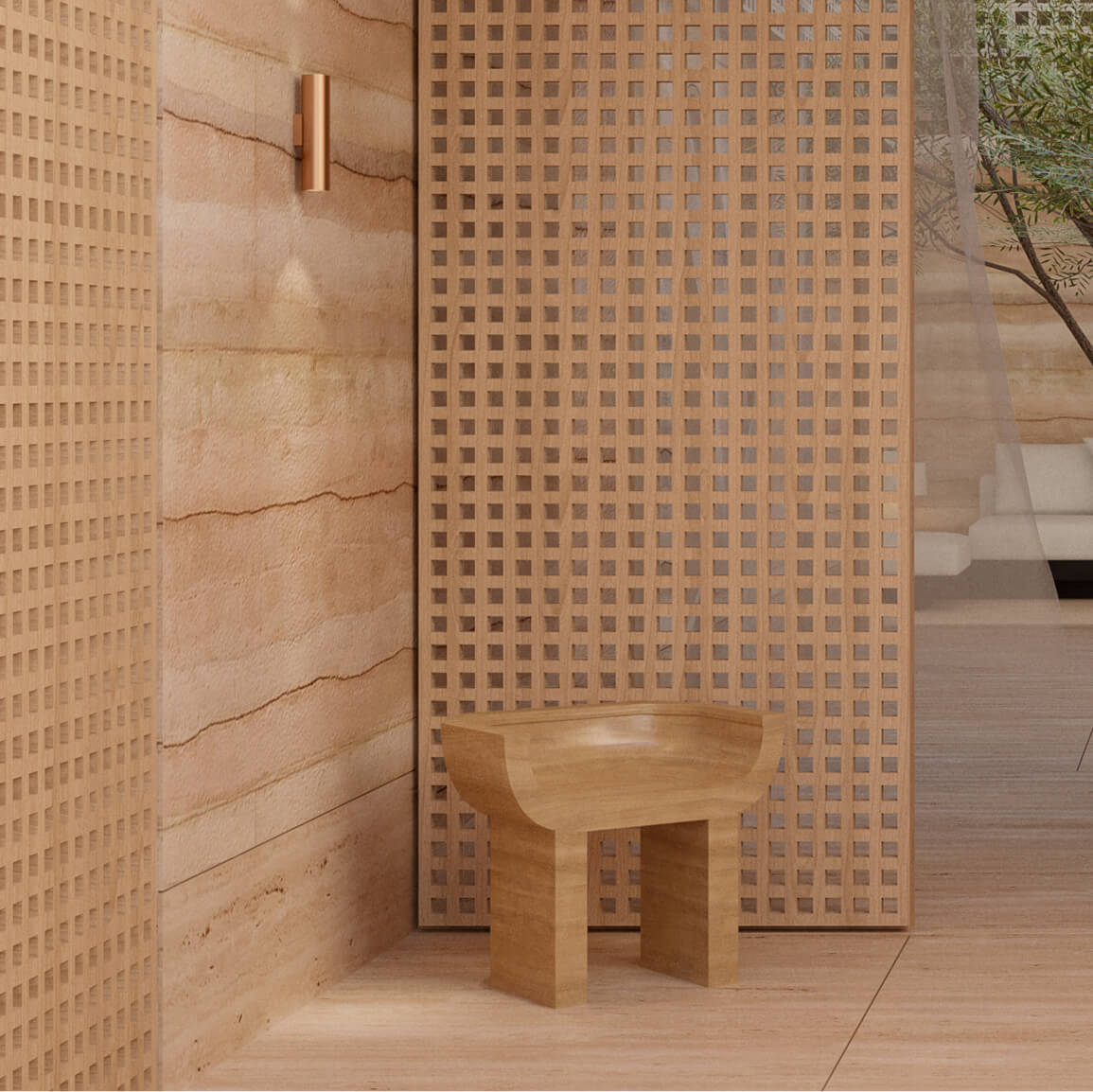
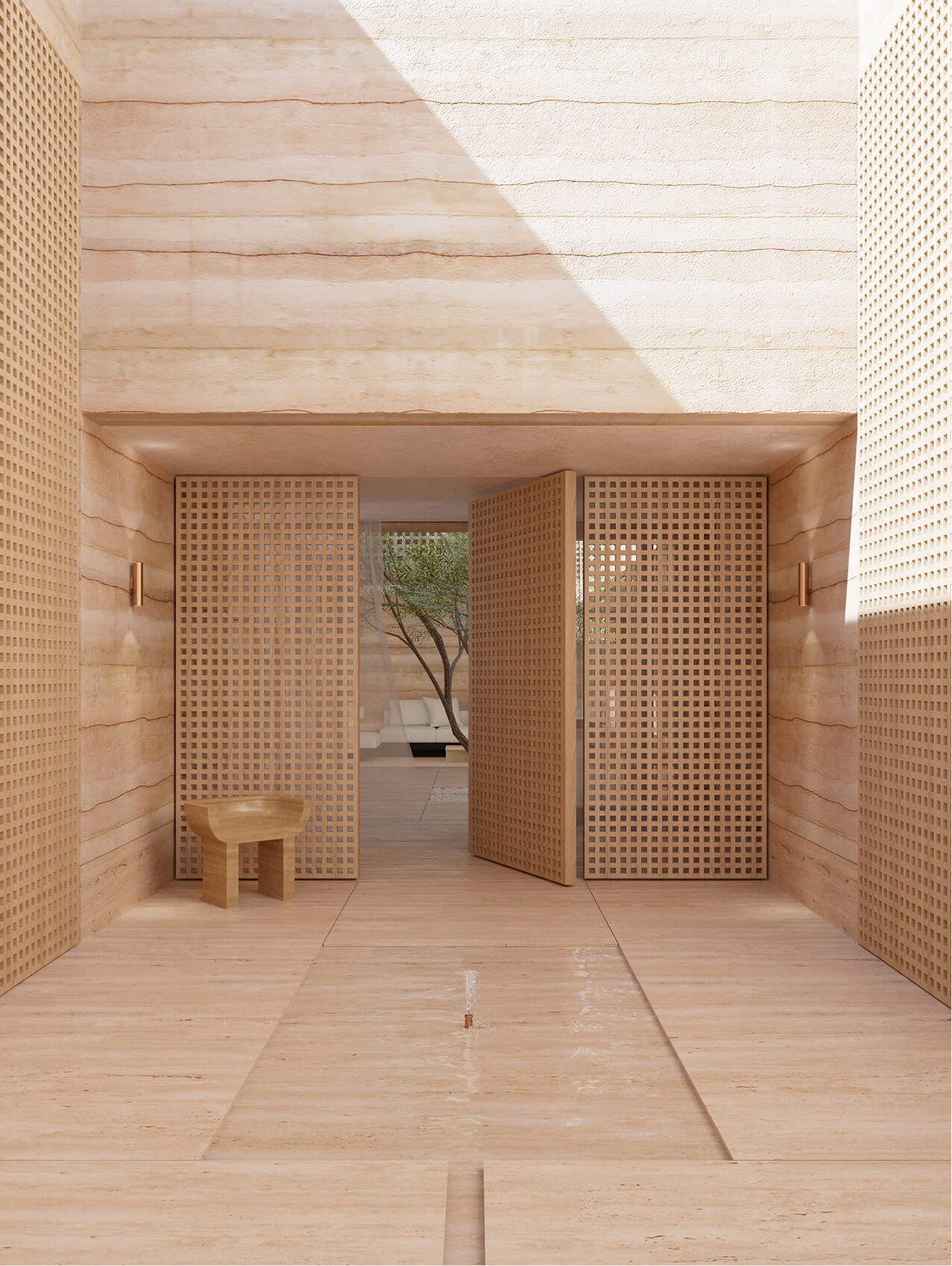
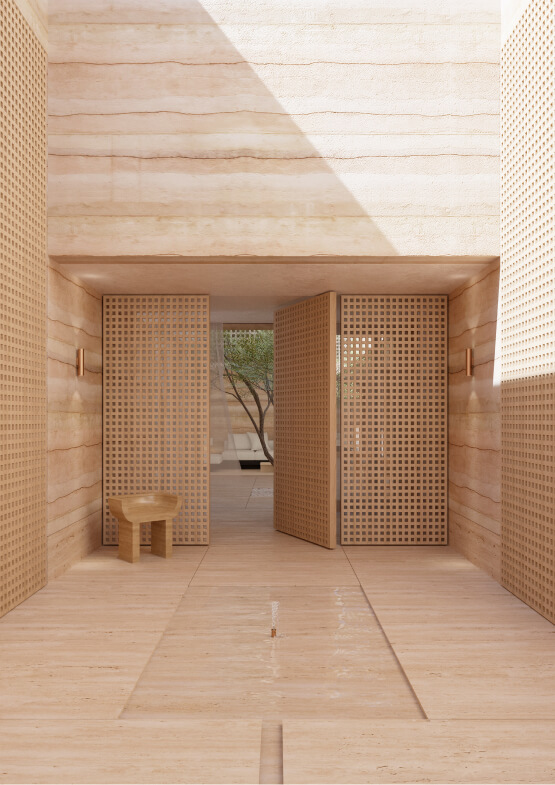
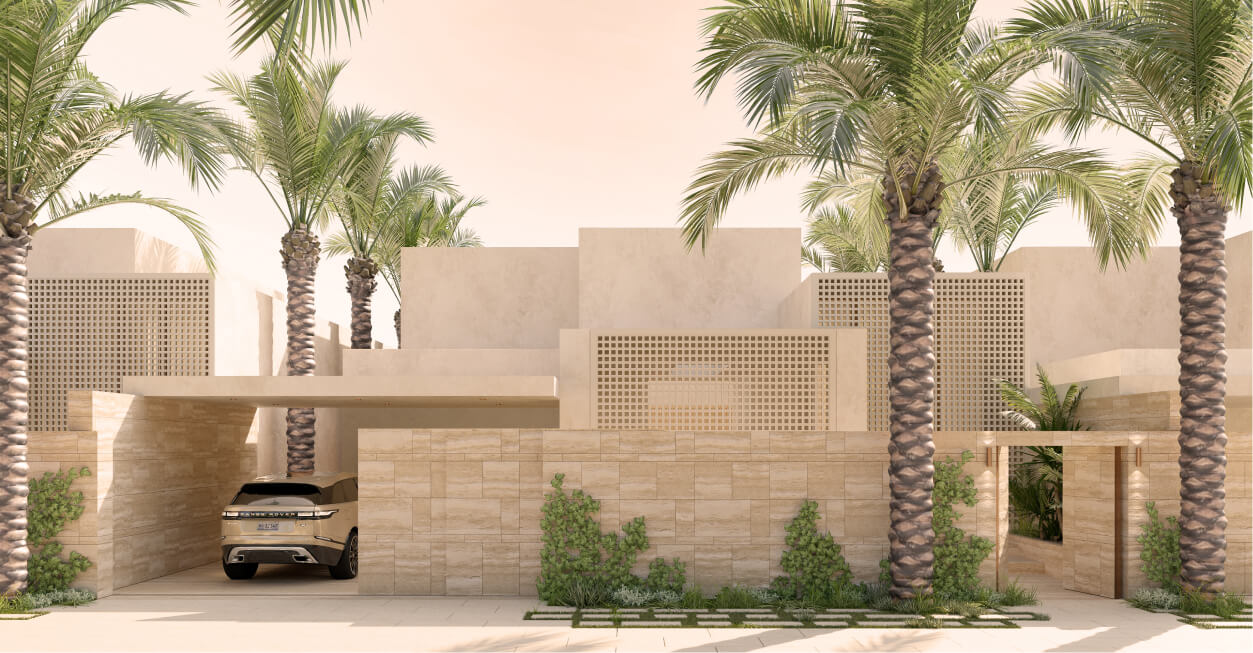
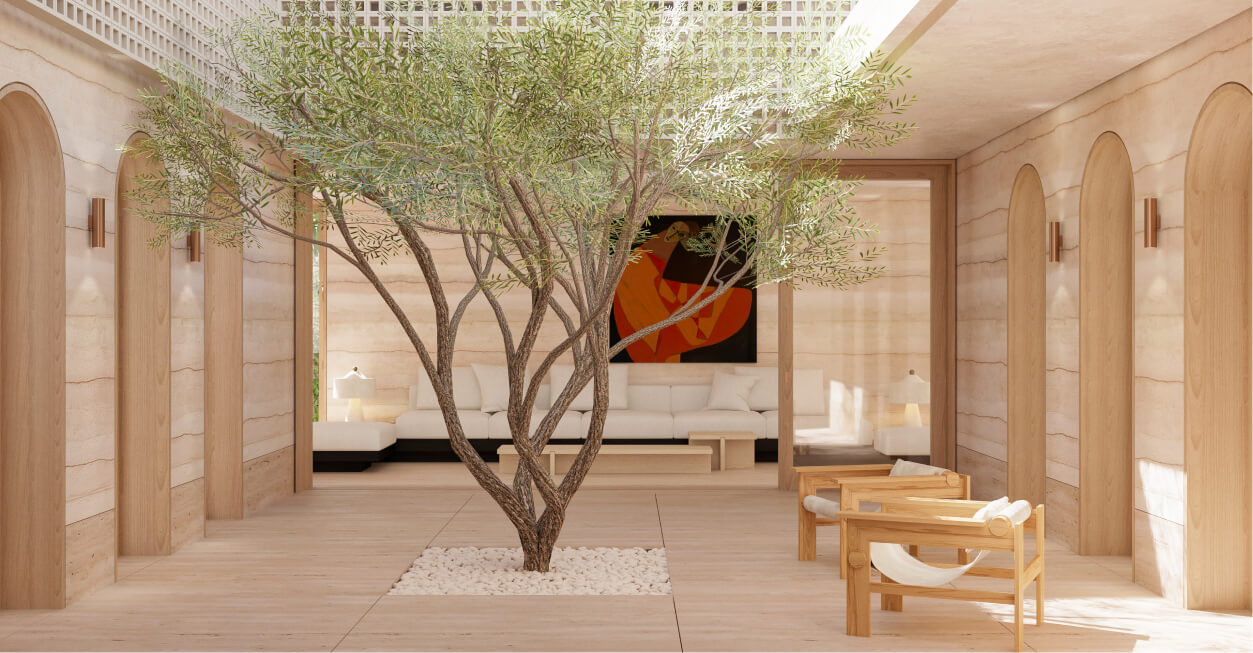
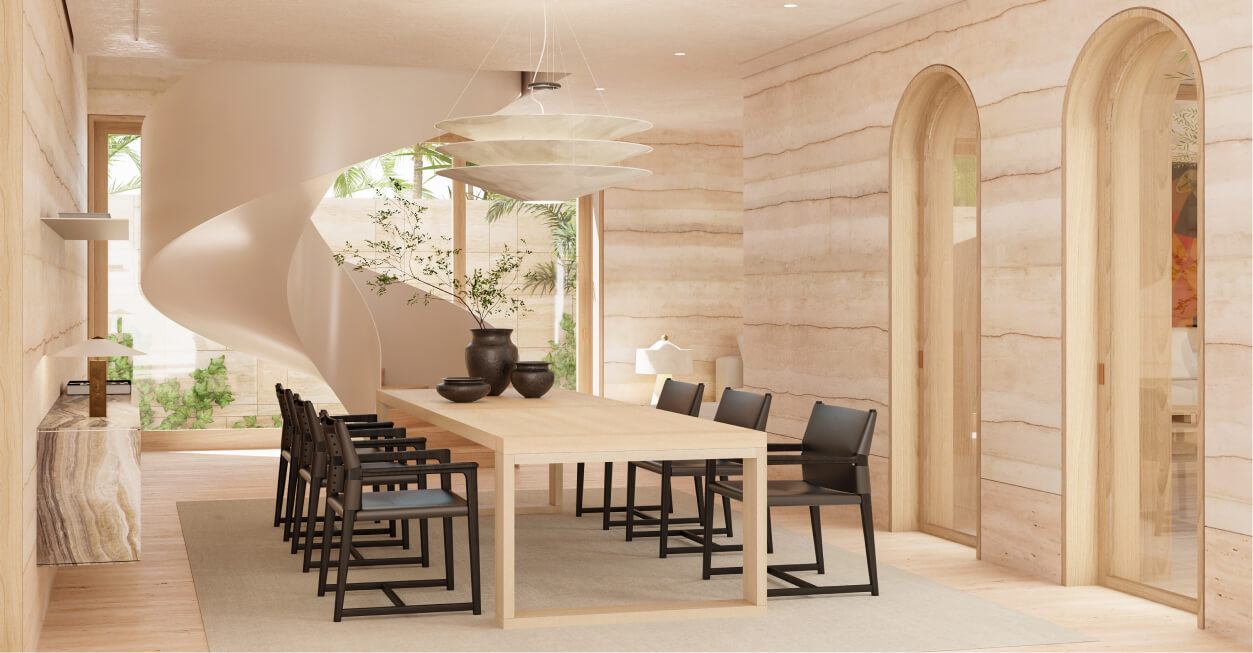
The social patio welcomes visitors, marking the threshold to the private family courtyard. Purity and minimalism, softly realized through the synthesis of irreducible elements: water, stone and light.

House, Community, and Microclimate
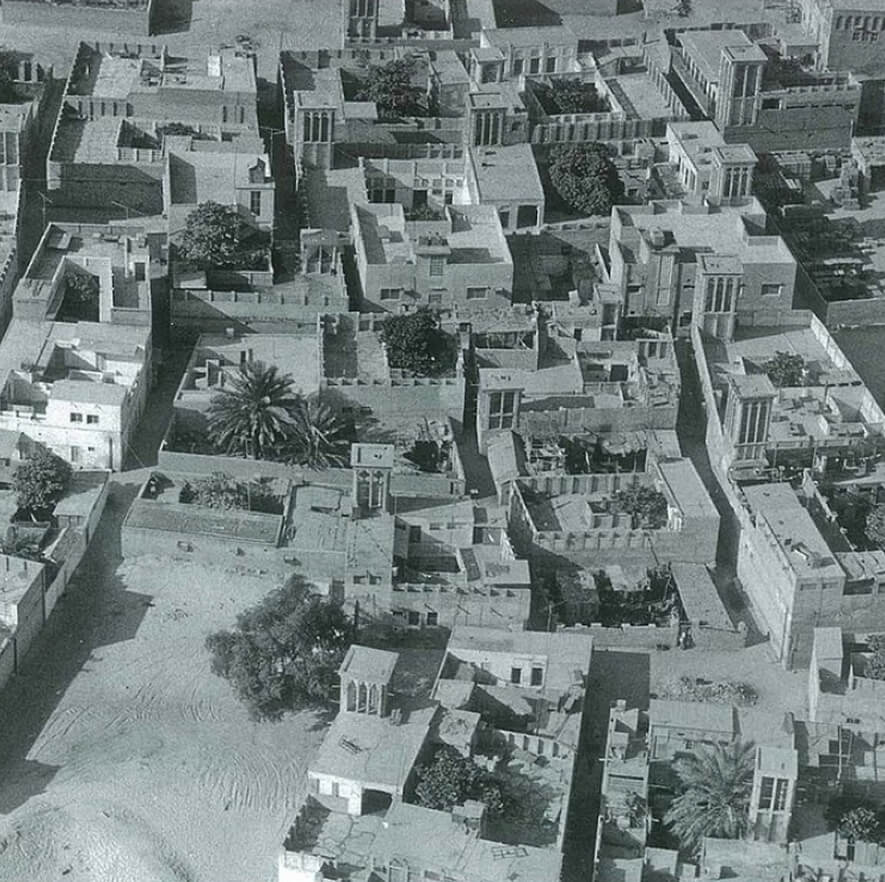
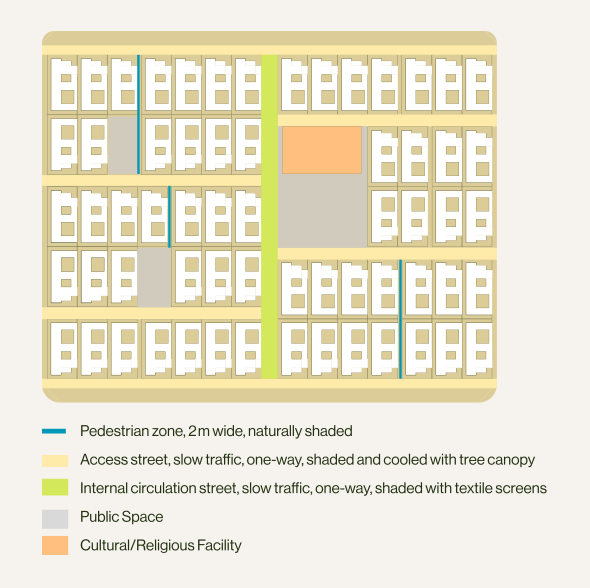
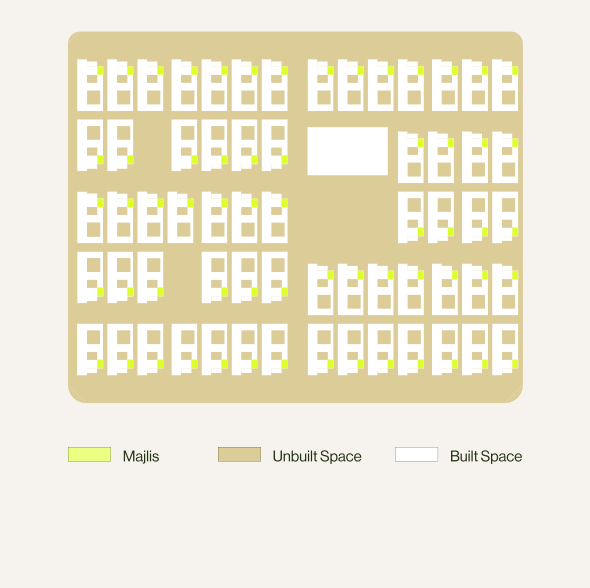
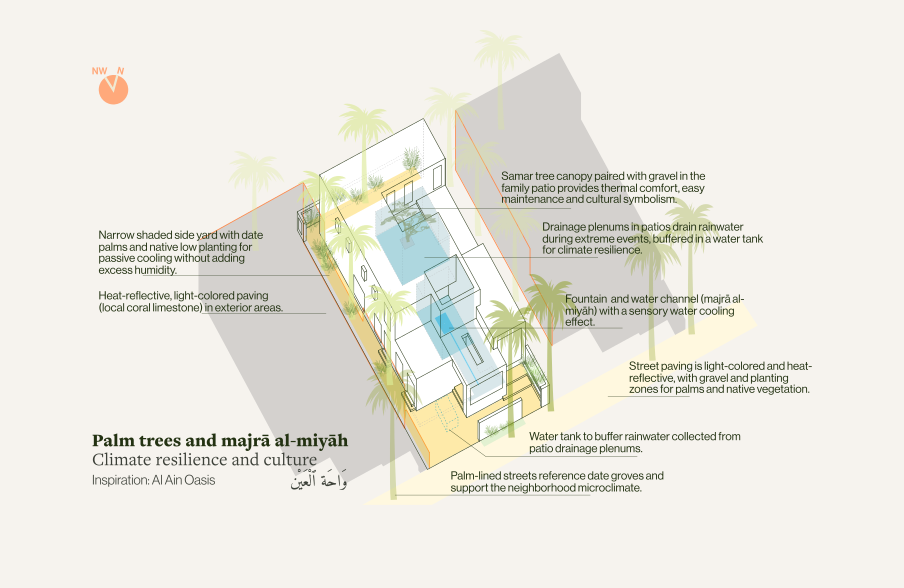
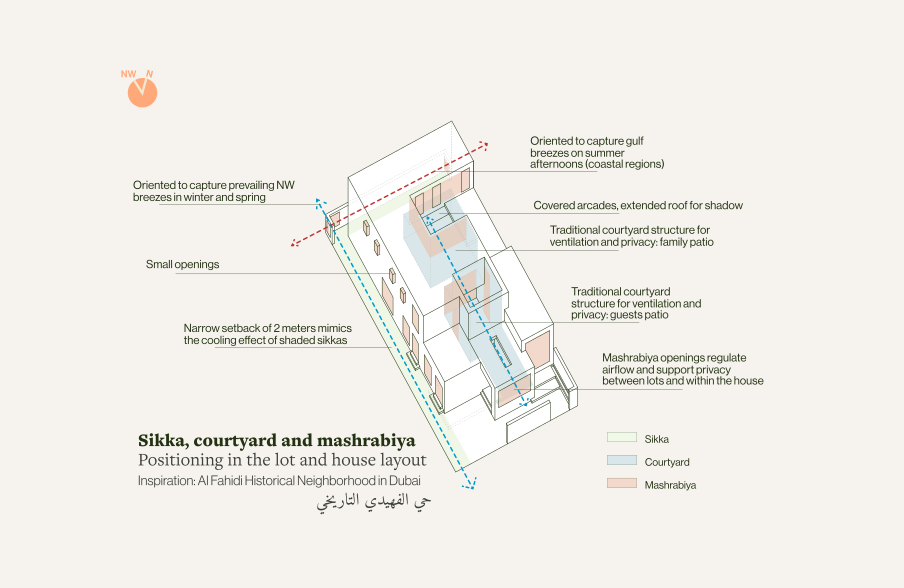
Operating across the domestic and urban scales, the design transforms the dwelling into an active climate device. It leverages narrow setbacks, shaded courtyards, and carefully placed openings to capture prevailing winds, driving natural airflow and creating vital areas of cooling shade. These same principles extend outward, shaping a compact neighborhood of sixty-two houses inspired by Al Fahidi’s dense urban fabric.
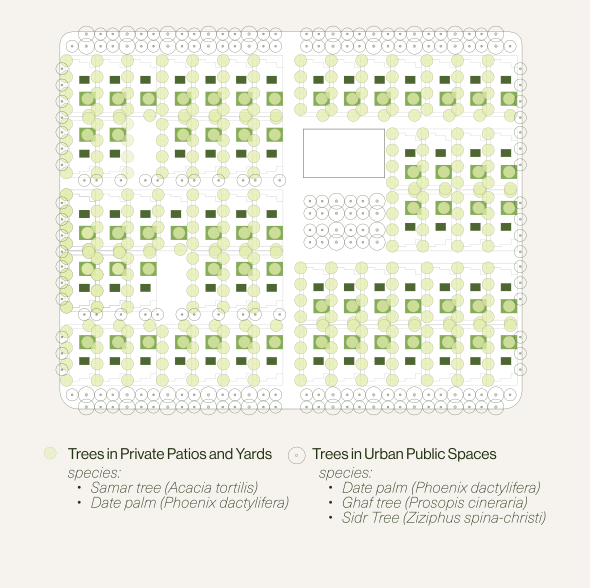
This structure fosters both comfort and community. Local trees, and light-colored limestone paving form a layered canopy that reduces heat and enhances walkability. A shared cultural and religious center anchors the plan, providing continuity and social cohesion between generations.
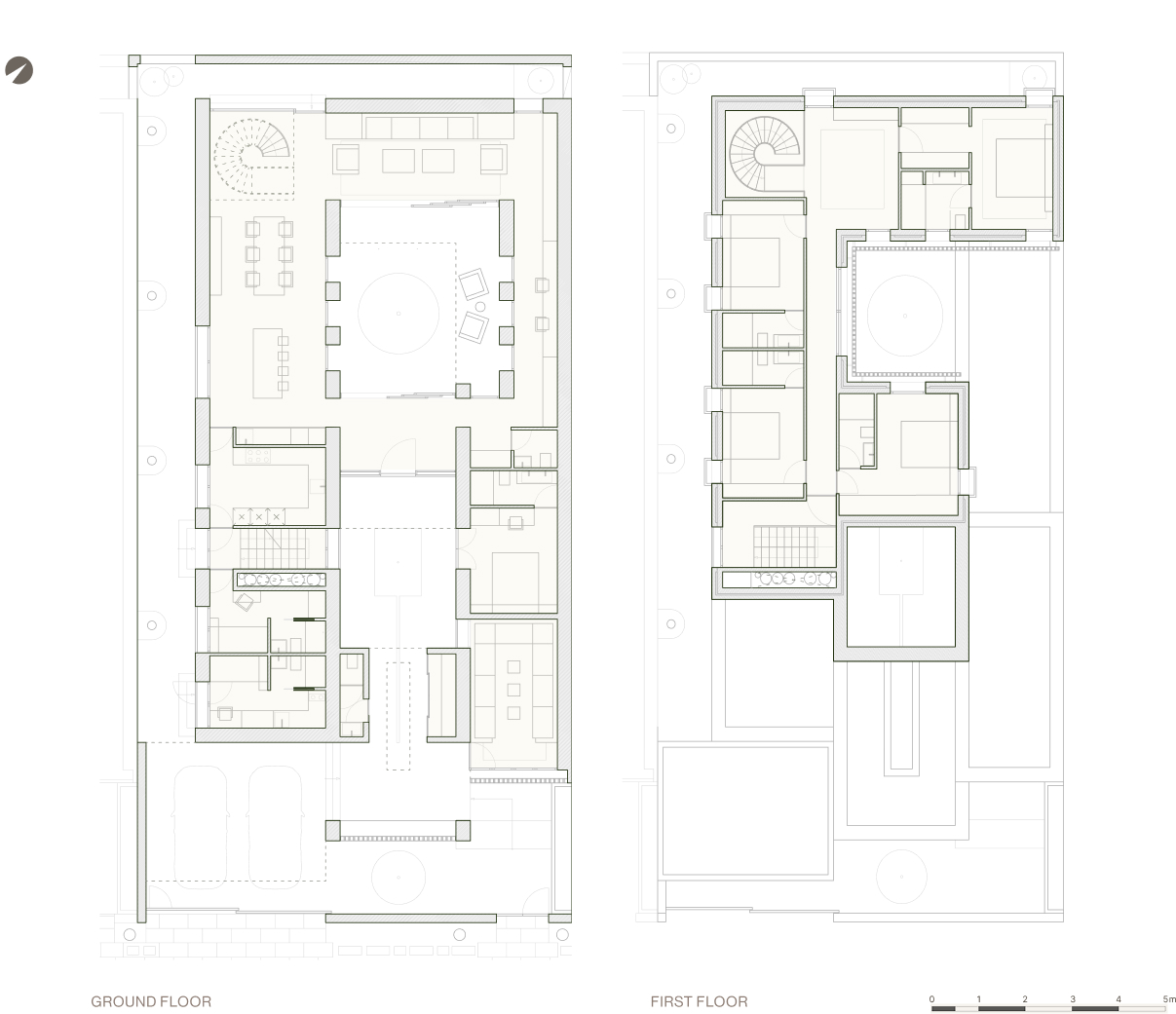
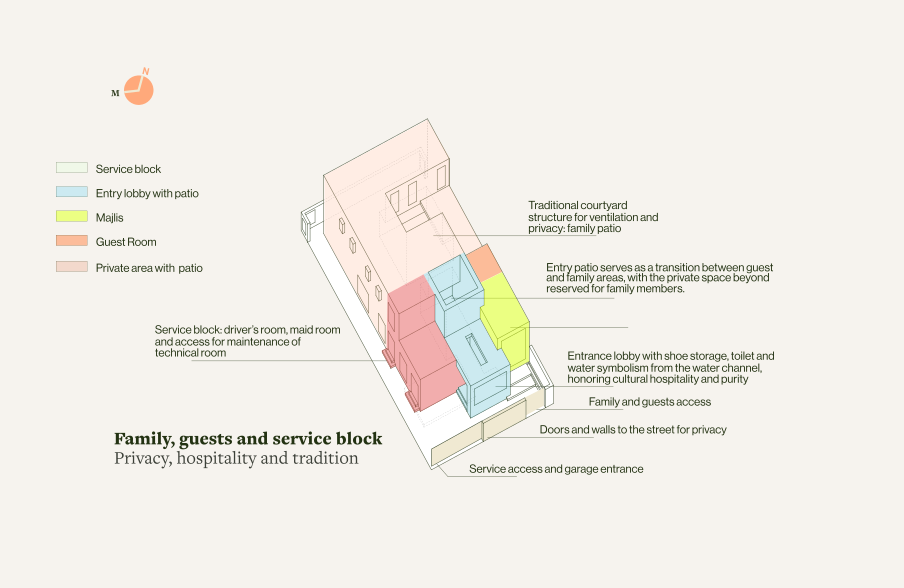
Central to Emirati culture, privacy dictates the floor plan and user experience. This home is efficiently separated into family and guest patios, each featuring mashrabiya openings that ensure controlled access, superior cross-ventilation, and strategic visual screening.
Humid Summers, Dry Winters
Al-Fajr adapts to the Gulf’s extreme climate with a hybrid passive-active system that operates autonomously and off-grid.
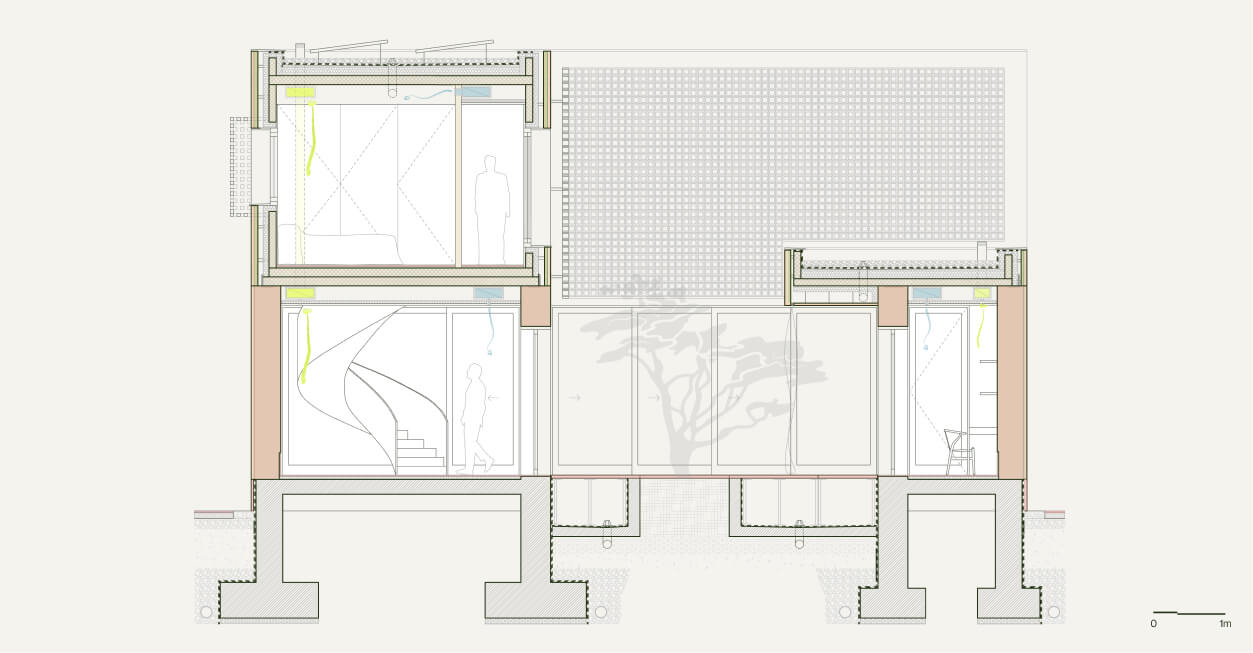
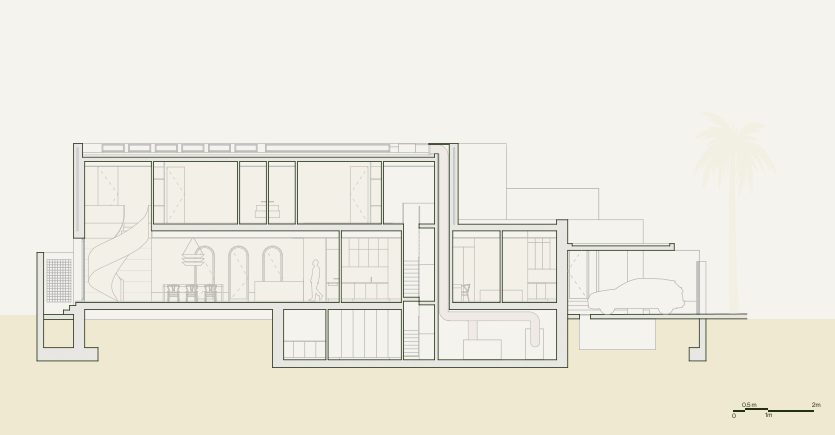
In summer, a solar-powered dehumidification system captures and dries outdoor air before channeling it through underground trench ducts, where it cools naturally to around 23 °C. The process eliminates up to half of the ambient humidity and provides filtered, comfortable air without mechanical HVAC systems.
In winter, the house relies entirely on passive design: its thick earthen walls store daytime heat and release it slowly at night, while the layout captures low sun angles to maintain thermal comfort through the mild season.
Innovation and Local Materials
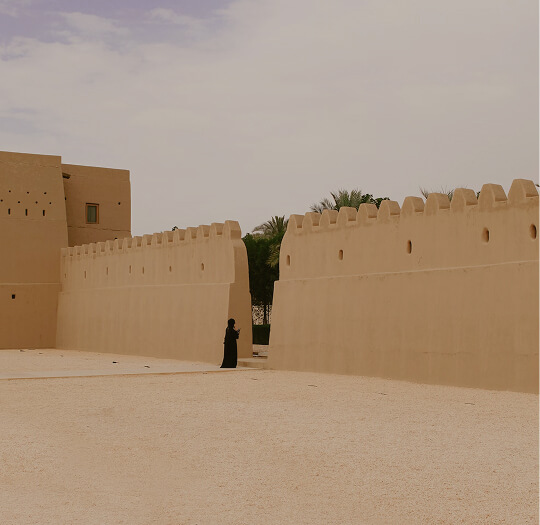
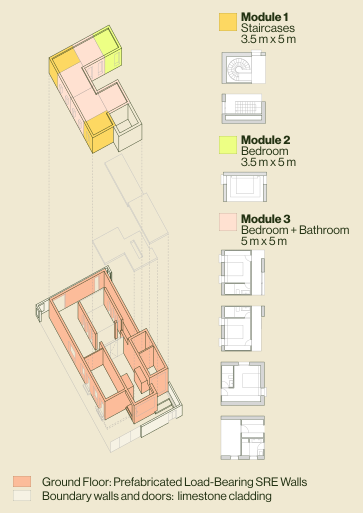
The construction merges ancient and modern technologies into one coherent system. The ground floor is built from stabilized rammed earth—an ancestral Gulf technique revived for its thermal mass and low embodied energy. The first floor employs prefabricated Cross-Laminated Timber (CLT) modules insulated with cellular glass and clad in palm fiber–clay composite panels. Together they create a light-over-heavy structure that balances permanence and adaptability.
The house stands on an elevated base to prevent flooding and promote durability. Its lime-plastered façades reflect sunlight and breathe naturally, while modular logic allows the dwelling to expand vertically as family needs evolve. Additional CLT units can be added over time, or omitted for a compact starter version, maintaining spatial integrity in either scenario.
A Living System of Growth
Al-Fajr begins as a single house, but its structure and principles—microclimate, modularity, and community—enable it to grow organically into a resilient neighborhood. The project envisions a future where architectural innovation is not about novelty, but about continuity: where technology amplifies tradition, and homes evolve like living organisms, rooted in culture yet open to change.